

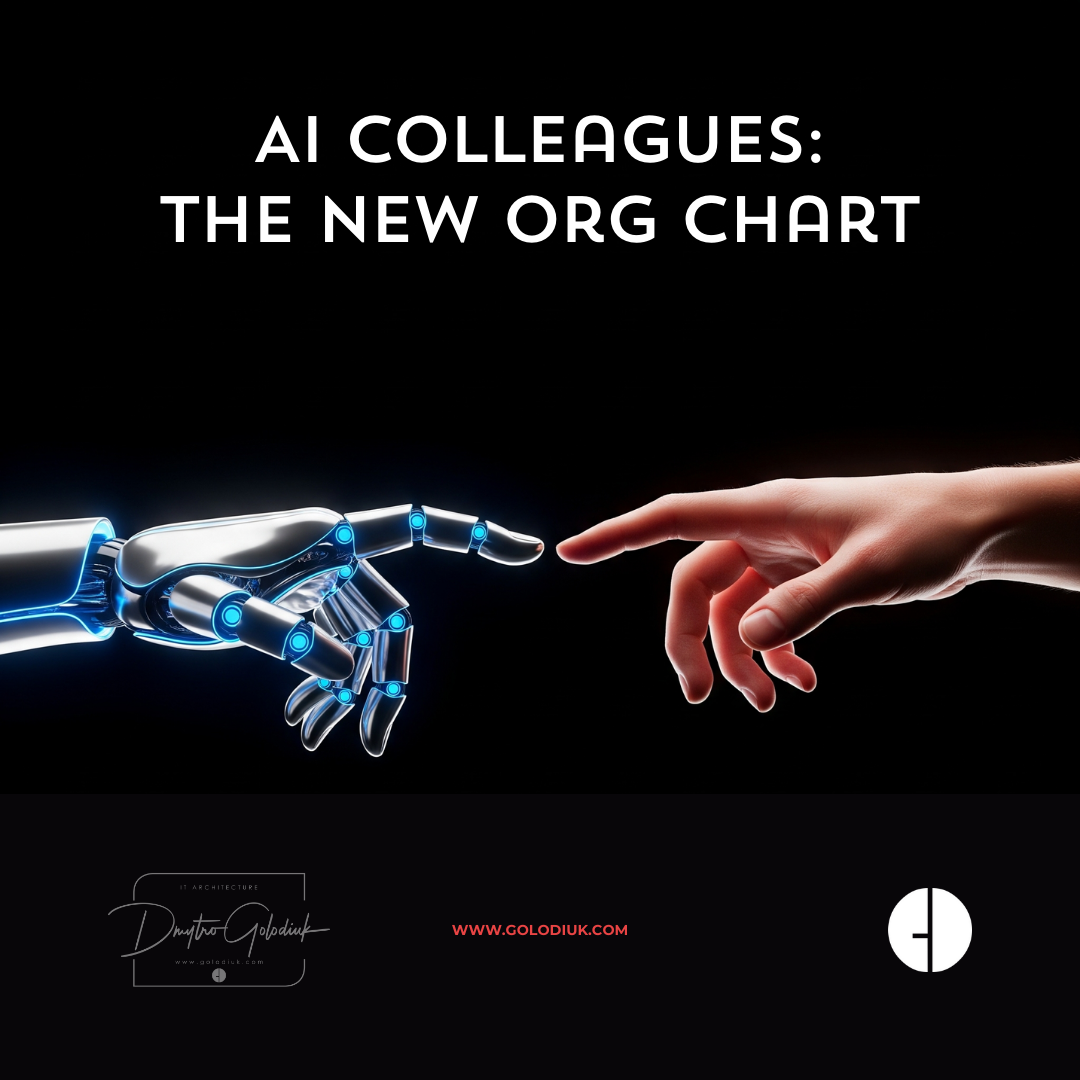
AI colleagues are reshaping the modern workforce. This article explores the new organizational chart, detailing the architectural and psychological shifts required to lead in an age of human-AI collaboration.
1. The New Org Chart
Introduction: The Ghost in the Machine, Now a Colleague
A profound transformation is underway in the corporate landscape. The traditional org chart, once a static representation of human roles and responsibilities, is being fundamentally re-engineered. This is not a distant, futuristic concept; it is happening now. Across industries, a new species of colleague – the AI agent – is being embedded into core business processes, working alongside human team members to summarize research, draft reports, and analyze complex data. This emergence has forced a critical re-evaluation of what work looks like, challenging leaders and architects to redefine accountability, reliability, and performance within a hybrid human-AI framework.
This rapid and disruptive shift has created a stark psychological divide within the workforce. On one side, there are those who view the change with a Fear of Missing Out (FOMO), embracing AI as a powerful tool to enhance their capabilities and seize new opportunities. On the other, a sense of Technological Fatalism or Apocalyptic Apathy prevails, where AI is seen as an unstoppable, job-displacing force. This article will move beyond this simple dichotomy to provide a strategic and architectural blueprint for navigating this new reality. It will demonstrate that the successful integration of AI agents is not merely a technical challenge but a holistic one that requires a new architectural philosophy, a deep understanding of human psychology, and a visionary approach to leadership.
Enterprise Architecture’s New Model: From Blueprint to Nervous System
The traditional roles of enterprise and solution architecture have been defined by their scope and focus. An enterprise architect (EA) is concerned with the entire IT landscape, ensuring that the technology strategy aligns with the overarching goals of the organization. In contrast, a solution architect (SA) concentrates on addressing a single, specific business problem at a time, designing and implementing a solution for a particular business issue. For years, enterprise architecture has operated on a cyclical, static model, with IT landscape reviews and updates occurring on a quarterly or annual basis. However, the unprecedented acceleration of AI and generative AI technologies has exposed the critical limitations of this traditional approach. Manual and static architectural practices simply cannot keep pace with the dynamic business needs and rapid technological evolution of the AI era.
The new mandate for enterprise architecture is a philosophical shift from a static blueprint to a dynamic, living nervous system. AI integration is fundamentally reshaping the EA discipline, transforming it from a hindsight-based process to a foresight-driven one. Organizations that ignore this AI-driven approach will inevitably fall behind competitors who are leveraging these technologies to make faster, smarter decisions about their IT systems. This transformation demands that EAs rebuild their digital foundations with AI at the core, moving beyond a cyclical review model to one of continuous, real-time analysis. This means EAs must pivot their skills from static planning to a focus on data consistency, predictive modeling, and the automation of routine tasks. The EA’s role evolves from a top-down designer to an orchestrator or “co-pilot,” working alongside AI tools to guide decision-making and modeling. This change is a direct consequence of the speed of AI development. Because AI advancements, particularly in large language models (LLMs) and generative capabilities, far outpace traditional IT planning cycles, a static EA model becomes a significant bottleneck. To keep up with the demand for real-time insights and adaptable systems, enterprise architecture must become a continuous, dynamic process. It must transform into a living ecosystem or neural network that constantly ingests data and provides real-time feedback, enabling proactive adjustments rather than reactive responses.
The Solution Architect’s Evolving Role: Designing for the Human-AI Interface
The solution architect’s role is also undergoing a significant evolution. While still focused on specific business problems, the nature of those problems is changing as they increasingly involve the integration of AI agents. The central challenge for SAs is to design and implement agile, human-centric solutions that incorporate AI while maintaining a seamless, collaborative experience. Key principles for this new role include employing agile methods, using iterative prototyping, and ensuring that technical blueprints are closely aligned with business objectives.
The integration of AI agents introduces a host of new challenges for solution architects, including the need to manage scalability, reliability, and compliance, particularly when integrating new AI solutions with complex legacy systems. An SA’s design must prioritize a “human-in-the-loop” approach, balancing full automation with human oversight to prevent unanticipated errors and ensure transparency. This requires designing for a personalized user experience where the AI’s functionality is intuitive, adaptable to user needs, and easy to understand. By shifting their focus to the design of the human-AI interface, SAs become the key enablers of the new hybrid workforce.
2. The Architecture of the Hybrid Workforce
AI Agent as a New Species of Colleague
An AI agent is more than a simple tool; it is a software system with a level of autonomy that allows it to pursue goals and complete tasks on behalf of users. Unlike a traditional bot that follows pre-defined rules, an AI agent can show reasoning, planning, and memory, and it has the ability to learn and adapt over time. This is its most distinguishing characteristic: its proactive, goal-oriented nature.
The anatomy of an AI agent can be understood through a set of core components.
- The “brain” is typically a large language model (LLM) or foundation model, which serves as the reasoning and decision engine, enabling the agent to process and generate language.
- The “memory” is augmented by external databases – such as vector, graph, or structured databases – to provide long-term knowledge and maintain context for multi-step tasks, addressing the inherent unreliability of LLM recall capabilities.
- The agent’s “tools” allow it to operate beyond its core model, enabling it to call external APIs, interact with CRMs, or use specialized software like a calculator to perform specific, energy-intensive tasks more efficiently.
- The agent’s “senses” are its multimodal capacity to process diverse information inputs, including text, voice, video, audio, and code simultaneously.
- Finally, “guardrails” or safety protocols are essential components that enforce trust, compliance, and safety, ensuring that the agent’s actions align with defined rules and standards.
The distinction between AI agents, AI assistants (or co-pilots), and simple bots is a crucial one, with the key differentiator being the agent’s ability to act proactively and autonomously.
Models of Human-AI Collaboration
The integration of AI agents is giving rise to a variety of new collaboration models. These models range from simple, single-agent systems to complex multi-agent architectures. A single-agent system involves an agent operating independently to achieve a specific, well-defined goal. However, for more complex tasks, multi-agent systems (MAS) are emerging, where multiple AI agents collaborate or even compete to achieve a common objective.
These MAS can be structured in several ways :
- Sequential Collaboration: Agents pass tasks along a defined pipeline, with each agent adding value before handing the result to the next, much like an assembly line.
- Parallel Collaboration: Multiple agents work simultaneously on different aspects of a problem, enabling greater processing speed and diverse analysis.
- Hierarchical Collaboration: A “supervisor” or “orchestrator” agent manages and directs specialized subordinate agents, mirroring traditional human organizational structures.
- Decentralized Collaboration: Autonomous agents coordinate without central control, creating resilient systems with no single point of failure and remarkable scalability.
The emergence of these new team dynamics confirms that AI agents are not just tools but embedded contributors and digital entities. This necessitates a fundamental shift in how organizations approach talent management. The conventional talent strategy must evolve to encompass these digital workers, with new processes for “onboarding, learning, upskilling, and performance measurement” that apply to both human and digital labor. The fact that AI agents have predictable needs, such as data and clear guidance, makes their management distinct yet complementary to that of human employees. This evolution is creating entirely new job roles, such as the “AI Workflow Orchestrator” and “AI Agent Trainer/Manager,” which are dedicated to designing and overseeing the collaboration between humans and AI. The establishment of roles like the “Chief of Agents” is a direct consequence of this new reality, reinforcing the view of AI agents as legitimate colleagues on the org chart.
Real-World Case Studies in Action
Several real-world cases highlight how AI agents are already transforming workflows at scale, combining technical feasibility with practical business value. From enterprise platforms to government initiatives, these examples demonstrate how solution and enterprise architects can design modular, orchestrated systems where AI agents collaborate like human colleagues.
Singapore Government – Multi-Agent System for CRM Insights
GovTech’s AI Practice team, working alongside SkillsFuture Singapore, has pioneered a multi-agent framework that models AI agents as virtual “government officers” to enhance CRM data insights. In this setup:
Business agents – such as assistant_director_agent, business_analyst_agent, and deputy_director_agent – act like specialized roles within a government department. They coordinate workflows, interpret user intent, break questions into sub-tasks, and consolidate findings.
Data agents execute technical tasks, like running graph queries, extracting structured data from knowledge bases, or executing code-based analyses.
When a user asks a policy or operations-related question, the agents collaborate seamlessly: business agents handle orchestration, while data agents retrieve and process relevant data. The response is a coherent, contextually accurate answer – essentially simulating the behavior of a cross-functional team of human officers, but at machine speed. This shows how governments can leverage AI to improve service quality while maintaining structured accountability.
ℹ️ Government Services
Salesforce – AI Agents for Enterprise Architecture
Salesforce’s Enterprise Architecture (EA) Agent acts like a virtual compliance consultant for solution architects. Built on Salesforce’s Agentforce platform and powered by its Data Cloud, the EA Agent ingests over 100,000 internal documents – including policies, technical standards, and design guides – and reviews solution designs automatically. Before any human review, it flags compliance gaps, suggests best practices, and cross-references relevant policies, saving architects countless hours otherwise spent scanning documentation.
ℹ️ Technological Business
How Salesforce’s New EA Agent Scales AI to Transform Enterprise Architecture
Geotab – Natural-Language Fleet Insights
Geotab, a global leader in fleet telematics, built a natural-language AI agent that turns everyday questions into SQL queries. Fleet managers can ask, “How many trucks exceeded 60 mph last week?”, and the agent handles the database queries behind the scenes. This demonstrates how multi-modal orchestration – combining natural language understanding, structured data retrieval, and business logic – unlocks high-value analytics without requiring technical expertise from end users.
Travel Industry – Priceline and Booking.com
The travel sector is aggressively adopting agentic AI. Priceline’s voice assistant, Penny, uses OpenAI Whisper for real-time speech recognition and streams replies back via WebSockets, enabling a seamless, conversational booking experience. Meanwhile, Booking.com’s Trip Planner integrates recommendation engines, intent detection, and a generative “orchestrator” module to craft personalized travel itineraries. Each of these services relies on orchestrated multi-agent designs: one module retrieves data, another recommends, and a third presents human-like conversational results.
Across these examples, a pattern emerges: AI agents succeed when they’re designed as specialized, modular components that interact via APIs, orchestration layers, or event-driven pipelines. Whether it’s the Singapore Government simulating virtual officers, Salesforce augmenting architecture compliance, Geotab democratizing data insights, or Booking.com crafting contextual travel experiences, the architecture principles remain the same:
- Clearly define agent roles and boundaries.
- Integrate them into enterprise systems via APIs and RAG pipelines.
- Treat AI agents as first-class “digital colleagues” within workflows.
These case studies prove that agentic AI is no longer experimental. With well-architected orchestration and robust data integration, AI agents are quietly reshaping how organizations – public and private – deliver value.
3. Confronting the Great Divide
The FOMO Mindset: The Optimistic Innovators
This psychological profile represents the proactive, efficiency-driven approach to AI adoption. This group sees AI as a catalyst for innovation and a powerful amplifier of human capabilities. They understand that AI can handle repetitive, mundane tasks, freeing them to focus on work that requires empathy, critical thinking, and complex collaboration. For them, AI is a supportive partner, not a disruptive force.
This mindset is driven by several key psychological factors.
- The first is the tendency for people to adopt new behaviors when they see others doing it. This creates a social pressure to avoid “falling behind” and accelerates the adoption of AI tools within an organization.
- The second is the “superagency” mindset, a state where individuals, empowered by AI, can supercharge their creativity and productivity.
By lowering skill barriers and automating cognitive functions, AI can enable more efficient problem-solving and innovation, leading to a sense of empowerment and enhanced professional value.
The Fatalist Fallacy: The Anxious and the Apathetic
In contrast to FOMO, the fatalist mindset is rooted in fear and anxiety about the future of work. This group is concerned about job displacement, the ethical implications of data collection, and a perceived “loss of control” over their professional lives. This perspective is often tied to the concept of technological determinism, the belief that technology is an unstoppable force beyond human control that dictates the course of society.
The psychological impacts of this mindset are significant. “Technostress,” the struggle to keep pace with rapidly evolving technology, can lead to feelings of being overwhelmed and “left behind” when companies integrate AI without providing adequate training and support. Furthermore, an over-reliance on AI can lead to a “loss of control,” where a person feels they can no longer make independent decisions without consulting an AI tool, which can result in a crisis of professional identity and diminished critical thinking skills.
The Human Psyche is Not a Binary. It’s a Spectrum of Trust.
The division of the workforce into two neat categories – the optimistic innovators and the fatalistic laggards – is a simplification that belies a more complex reality. An employee might be excited about AI’s potential to automate mundane tasks, yet simultaneously anxious about its long-term impact on their career. The true unifying factor underlying this spectrum of reactions is trust.
A surprising number of workers would rather have an AI manager than a human one, with a survey showing that 38% of workers share this preference. This seemingly counter-intuitive finding is a symptom of a deeper crisis of trust in human management. A significant portion of the workforce perceives AI as more objective and fairer than their human counterparts. Research indicates that when employees anticipate bias or favoritism from a human supervisor, they rate AI evaluations as more trustworthy. AI systems, which make decisions based on data and predetermined criteria, are seen as a compelling alternative to human managers who may be influenced by personal relationships or office politics.
ℹ️ Note
CalypsoAI’s Insider AI Threat Report finds 52% of U.S. employees are willing to use AI to make their job easier, even if it means violating company policy
This lack of trust is not without cause. A separate study reveals that over half of workers believe AI is faster and more knowledgeable than their managers, and nearly 40% feel more comfortable asking AI questions than their bosses. This is compounded by the fact that many managers lack formal training, with one report noting that 82% of managers fall into their role by chance. The central implication of this analysis is that the psychological “problem” with AI adoption is not the technology itself, but a reflection of pre-existing organizational dysfunctions. The architectural and leadership challenge, therefore, is not just to integrate AI effectively, but to build a culture of transparency, fairness, and psychological safety that makes the human-AI partnership a trusted one.
ℹ️ Note
4. The Architect’s Blueprint for the Future
A New Architectural Philosophy: Human-First, AI-Enabled
The successful integration of AI agents into the corporate org chart requires a new architectural philosophy. This philosophy must be “Human-First, AI-Enabled,” where the primary objective is to amplify human capabilities, not replace them. The architecture should be designed as a supportive partner rather than a disruptive one, enabling a seamless collaboration where AI handles repetitive tasks, freeing human employees to focus on empathy, critical thinking, and high-value work. This approach is essential for fostering an environment where employees feel supported, empowered, and engaged.
Strategic Architectural Principles
Principle 1: Unified Data as a Foundational Layer
The most significant bottleneck for AI initiatives is fragmented data and disconnected legacy systems. AI models require a complete and unified data picture to be effective, and data silos can kill an AI project before it even begins. Enterprise architects must address this foundational challenge by unifying scattered data sources into a cohesive, centralized system. This requires rebuilding data pipelines to process information in real-time, shifting from a model of hindsight to one of foresight. Additionally, automating data governance is critical to ensure clean, trustworthy data at scale. A key strategic decision for architects is determining whether to modernize incrementally or make a clean break from outdated systems.
Principle 2: Designing for Resilience and Scalability
AI systems must be designed to handle massive volumes of data, user traffic, and continuous training requirements. A single point of failure in a traditional centralized network can be catastrophic, taking down the entire system. To mitigate this risk, architects must build a modular, microservices-based architecture where each component can function independently, simplifying integration and maintenance. Employing a decentralized, multi-agent system architecture offers remarkable resilience, as the failure of one agent does not cause the entire system to fail. This approach also enhances scalability, as new agents can be seamlessly integrated to handle growing workloads.
Principle 3: Security, Governance, and Ethics as Core Tenets
The deployment of AI exposes new security gaps and introduces significant ethical and legal challenges. Ethical concerns such as bias, transparency, data privacy, and accountability must be addressed from the outset, not as an afterthought. To address this, architects must embed security and compliance measures into the core of AI systems. This includes using automated guardrails, continuous monitoring, and strict, role-based access controls to protect sensitive data. A robust governance framework with a “human-in-the-loop” approach is essential to maintain oversight, manage accountability when an agent makes a mistake, and avoid the risks of over-automation. Forward-thinking organizations are establishing dedicated “Ethical AI Teams” and “Data Review Boards” to run fairness tests and ensure that the AI’s decision-making processes comply with regulations and ethical standards.
Practical Implementation Guide for Solution Architects
The strategic principles outlined above can be translated into concrete, actionable steps for solution architects. The following checklist provides a practical guide for navigating the complexities of AI integration, addressing common challenges and providing valuable lessons learned from real-world deployments.
| Architectural Domain | Best Practices | Lessons Learned/Points of Attention |
|---|---|---|
| Agile Development | Employ agile methods and iterative prototyping; develop and test components in smaller, manageable microservices. | Break down project scope into smaller components to address implementation challenges discovered during testing. |
| Legacy Systems | Utilize incremental modernization approaches like the strangler fig pattern to gradually replace legacy components. | Early automation of legacy documentation can significantly reduce onboarding and maintenance costs. |
| Automation | Define clear automation policies with a human-in-the-loop approach to maintain oversight and accountability. | Balancing full automation with human oversight is crucial to avoid unanticipated errors; over-automation can be risky. |
| Scalability | Follow cloud-native design principles like microservices architecture to enhance scalability and resilience. | Ensure horizontal scalability to handle increasing data volumes and user traffic without performance degradation. |
| Security & Governance | Incorporate security and compliance measures from the outset; use automated guardrails and continuous monitoring. | Regularly audit AI systems to address biases, mitigate emerging threats, and ensure data privacy. |
| Operations (LLMOps) | Implement a continuous lifecycle management process for LLMs, including version control and automated retraining. | Establish robust retraining and version control processes to manage model drift and ensure long-term performance. |
Conclusion
The evolution of the corporate org chart to include AI agents is a strategic imperative, not a choice. The data is clear: the hybrid human-AI workforce is a present-day reality delivering quantifiable business value across a variety of industries. This transformation, however, is not just a technological one; it is deeply human. The psychological reactions of the workforce – from the optimism of the innovators to the anxiety of the fatalists – underscore that the central challenge is not a lack of AI capability, but a potential deficit of trust in the human and technological systems meant to support it.
The path forward requires a unified approach that marries robust architecture with visionary leadership. Enterprise architects must abandon static planning models in favor of dynamic, real-time systems that treat AI as a core component of the digital foundation. Solution architects must design with a “Human-First, AI-Enabled” philosophy, building systems that amplify human potential, not diminish it.
The choice is not between a future with AI or without it, nor is it a binary between FOMO and Fatalism. The true choice is between purposeful action and passive resignation. The responsibility lies with leaders and architects to be the engineers of trust, designing systems that are not only efficient and scalable but also equitable, transparent, and humane. The evolution of the org chart is a profound opportunity to reimagine work itself, creating a future where technology serves as a trusted partner, enabling unprecedented innovation and human-centric progress.
Thank you!